

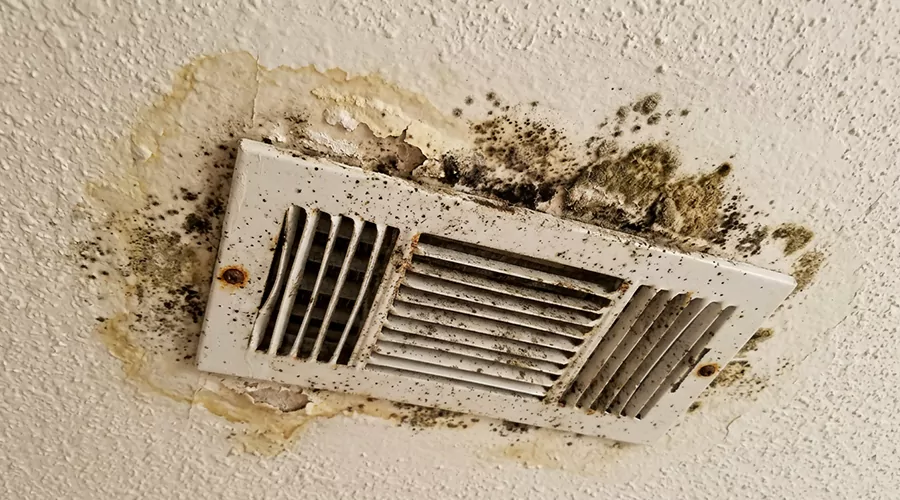
Mold around air vents usually develops when moisture collects on the vent cover or nearby wall and provides conditions for fungal growth. Condensation from cold supply air is a common cause, especially when indoor humidity is high. Mold may begin developing on damp materials within 24 to 48 hours under suitable conditions.
Air vents connect the heating and cooling system to occupied rooms. During cooling operation, supply grilles can become significantly colder than the surrounding air. When humid air contacts these surfaces, condensation may form and leave nearby paint or drywall damp. If moisture continues and suitable nutrients are present, mold can begin growing on affected materials.
However, dark marks around an air vent are not always mold. Household dust and airborne soot can also create black staining along vent edges. Distinguishing ordinary deposits from moisture-related growth helps homeowners avoid unnecessary treatments while addressing conditions that can damage surrounding surfaces.
What Causes Mold to Grow Around Air Vents?
Mold develops around vent openings when moisture remains on the grille or adjacent building materials. Cold supply air can create condensation under humid conditions, while water leaks may dampen the surrounding wall or ceiling. The source must be identified because surface cleaning alone will not stop recurring growth.
Condensation on Cold Supply Vents
Condensation occurs when a surface becomes colder than the dew point of the surrounding air. During air conditioning operation, metal supply grilles can reach temperatures low enough for indoor moisture to condense on them. Water droplets may collect along the edges and spread onto nearby paint.
Repeated moisture exposure creates conditions that can support fungal growth. Dust on the grille can provide nutrients, while painted drywall offers another surface where growth may develop. A vent that regularly appears damp during cooling deserves investigation even before visible discoloration becomes severe. Our air handler unit cleaning service addresses the equipment side of this moisture problem.
High Indoor Humidity
Indoor humidity plays a major role in condensation problems. When the air contains more moisture, the dew point rises and cold surfaces are more likely to become wet. Bathrooms and poorly ventilated rooms may experience higher humidity during everyday activities.
The CDC recommends maintaining indoor relative humidity at no more than 50% to help prevent mold growth. A digital hygrometer provides an inexpensive way to monitor conditions. If humidity remains elevated throughout the day, reducing moisture in the room can help prevent repeated condensation around cold vents.
Poorly Insulated Duct Connections
Supply ducts frequently travel through attics or other spaces where temperatures differ from those inside the home. Proper insulation helps prevent cold duct surfaces from interacting directly with warm humid air. When insulation is damaged or missing, condensation may develop on exposed materials.
Moisture can sometimes travel toward the register connection and affect surrounding drywall. Gaps around the vent boot may also allow humid attic air to reach colder surfaces. These conditions can make one ceiling vent develop repeated moisture problems while other vents remain dry.
Water Leaks Above the Ceiling
Not every damp vent is caused by air conditioning. A roof leak or damaged plumbing connection can introduce water into the ceiling cavity near a duct opening. The moisture may appear around the vent because the opening provides a visible path through the ceiling.
A water stain that remains visible when the HVAC system is off may suggest a building moisture problem rather than ordinary cooling condensation. Discoloration spreading beyond the grille is another reason to examine the surrounding area. Correcting the leak is necessary before damaged materials can dry properly.
Dust and Other Organic Deposits
Household particles collect around vent openings as air moves through the room. Dust can contain organic material that provides nutrients for mold when moisture is present. However, dust alone does not create fungal growth because sufficient water is still required.
The combination of repeated dampness and particle deposits is more concerning than ordinary dry dust. Cleaning loose particles may improve the appearance of a grille, but it will not prevent mold if the surface continues becoming wet. Moisture control remains the priority.
Why Does Mold Appear Around Ceiling Vents More Often?
Ceiling vents can develop moisture problems because cold supply grilles sit directly against painted ceilings. When humid room air reaches the cold metal, condensation may form along the edges. If water repeatedly reaches nearby drywall, the painted surface can become a location for mold growth.
Ceiling openings also connect to ductwork that may run through hot attics. Damaged insulation near the register boot can allow humid attic air to contact cold surfaces. Depending on the building design, gaps around the opening may increase the amount of moisture reaching the area.
The visible stain may not follow the exact shape of the vent cover. Water can spread across painted surfaces or enter small gaps in the surrounding material. This explains why discoloration may appear in one corner or extend several inches away from the grille.
The position of the vent alone cannot confirm the source. A ceiling register affected by a roof leak may look similar to one experiencing repeated condensation. Observing when the moisture appears provides a more useful clue.
How Can You Tell Mold From Dust Around an Air Vent?
Mold and ordinary particle staining may look similar when they collect around air vents. Dark marks do not automatically indicate fungal growth because dust can settle along airflow patterns. The presence of recurring moisture or visible surface deterioration makes a mold problem more concerning.
A dark outline following the grille's airflow direction often involves accumulated particles. Irregular growth on persistently damp drywall may indicate a different condition. However, visual appearance cannot always distinguish the materials reliably.
| Observation | Possible Explanation | What to Investigate |
|---|---|---|
| Dry black streaks along vent edges | Airborne dust or soot | Airflow and indoor particle sources |
| Damp dark patches on nearby drywall | Possible mold growth | Condensation or water intrusion |
| Repeated water droplets on grille | Surface condensation | Indoor humidity and grille temperature |
| Yellow or brown ceiling stain | Possible water damage | Roof or plumbing leaks |
| Dark material inside the duct opening | Dust or possible contamination | Actual duct condition |
| Peeling paint around the register | Repeated moisture exposure | Water source and damaged building material |
A persistent musty smell can provide another reason to investigate, but it does not prove that the vent itself contains mold. Odors can originate from other damp areas of the building. Similarly, a dry surface does not guarantee that concealed insulation or drywall is unaffected.
If suspected growth extends behind the grille or into the HVAC system, avoid scraping the material to identify it. Disturbing contamination may release particles into occupied rooms.
What Are the Warning Signs of Mold Around Air Vents?
Early moisture problems can be easier to correct before surrounding materials become damaged. The most useful warning signs involve recurring condensation and changes in nearby paint or drywall. Looking at the condition of the vent over several cooling cycles helps identify persistent problems.
Common warning signs include:
- Water droplets repeatedly form on the metal supply grille.
- Dark irregular patches appear on damp paint near the vent.
- A musty odor develops around the affected opening.
- Paint begins peeling or bubbling near the grille.
- Water stains extend beyond the vent frame.
- Nearby drywall feels soft or shows signs of swelling.
- Discoloration returns after the surface has been cleaned.
- Indoor humidity frequently remains above 50%.
- Insulation around an accessible duct connection appears damp.
- Visible growth appears on more than one moisture-affected surface.
These observations help determine whether the problem involves a single surface or a larger moisture issue. For example, droplets forming only during cooling may indicate condensation. Water damage that continues while the HVAC system is off may point toward another source.
The size of the affected area also matters. A small isolated spot on a washable grille requires a different response from widespread growth involving ceiling drywall. Identifying the affected material helps determine whether cleaning or replacement is appropriate.
How Quickly Can Mold Spread Around a Vent?
Mold can begin growing within 24 to 48 hours on damp materials when suitable conditions are present. However, visible growth does not follow the same timetable in every home. Surface temperature and the duration of moisture exposure affect how quickly the problem develops.
When condensation occurs occasionally and the surface dries completely, conditions may not support sustained growth. Repeated moisture exposure creates a greater concern because the surrounding material may never dry thoroughly. Porous drywall can also retain water beneath the visible painted surface.
| Moisture Condition | Possible Effect | Recommended Action |
|---|---|---|
| Brief condensation | Temporary surface dampness | Reduce humidity and dry the surface |
| Repeated condensation | Dust sticks to damp surfaces | Identify why the grille becomes wet |
| Moisture lasting 24 to 48 hours | Mold growth becomes possible | Correct the water source promptly |
| Persistent damp drywall | Potential material deterioration | Assess the affected area |
| Recurring visible growth | Moisture problem remains unresolved | Investigate hidden moisture sources |
This table describes possible outcomes rather than a guaranteed progression. Mold does not automatically spread throughout a home because one grille becomes damp. However, a continuing water problem can affect a larger area over time and increase the amount of material requiring cleanup.
How Can You Check Moisture Around an Air Vent?
A basic moisture inspection can help determine whether condensation is contributing to suspected mold around a grille. The purpose is to observe when dampness occurs without disturbing potentially contaminated material. Homeowners can often complete this initial check using a hygrometer and a flashlight.
Begin by examining the affected surface while the HVAC system is off. Record whether the grille appears dry and look for existing water stains. Measure the room's relative humidity and note whether moisture-producing activities have occurred recently.
The following observations can help identify a pattern:
- Photograph the grille and surrounding ceiling before cleaning.
- Measure indoor humidity with a digital hygrometer.
- Check whether water droplets appear during normal cooling.
- Look for water stains extending beyond the register frame.
- Compare the affected vent with similar openings in other rooms.
- Record whether dampness remains after the cooling system stops.
If there is credible evidence that the HVAC system itself contains mold, stop operating it until the condition is assessed. Do not remove damp internal insulation or use a household vacuum on suspected growth. The goal of this check is to locate possible moisture sources rather than perform mold remediation.
Can You Clean a Small Mold Spot Around an Air Vent Yourself?
Small amounts of confirmed mold on an accessible hard surface can sometimes be cleaned with detergent and water. However, the material and location determine whether household cleanup is appropriate. Suspected contamination inside the HVAC system should not be handled like an isolated spot on a washable exterior surface.
For general household mold cleanup, EPA guidance indicates that areas smaller than approximately 10 square feet can often be handled by homeowners under suitable conditions. This does not mean that ten square feet of suspected mold inside an HVAC system is safe for household cleaning. Contaminated insulation and hidden duct components require a different assessment.
If a small isolated spot is limited to a washable exterior grille and there is no evidence that the HVAC system is contaminated, the following approach may be suitable:
- Turn off the HVAC system before touching the affected cover.
- Wear suitable gloves and eye protection.
- Avoid brushing or scraping dry suspected growth.
- Clean the hard surface gently using detergent and water.
- Remove remaining moisture and dry the material completely.
- Correct the condition that caused the surface to become damp.
People with significant mold allergies or weakened immune systems should not perform mold cleanup themselves. If growth extends onto damaged drywall or into the duct opening, stop rather than attempting to remove concealed material.
Bleach is not necessary for routine mold cleanup on hard household surfaces. Mixing cleaning chemicals can also create dangerous fumes, particularly when bleach contacts ammonia-based products.
Why Does Mold Keep Returning Around the Same Vent?
Mold can return when the moisture source remains active after cleaning. The visible surface may look clean while the underlying temperature or humidity conditions stay unchanged. If condensation repeatedly develops during cooling cycles, the same area can become damp again.
A common example involves a cold ceiling grille surrounded by poorly insulated material. Cleaning the cover removes existing deposits, but it does not stop humid air from contacting the cold surface. New moisture can accumulate during the next period of heavy cooling.
Another possibility is water damage behind the ceiling. A leaking roof or plumbing connection may continue wetting the surrounding drywall even when the visible stain has been removed. The material can remain damp internally and develop recurring growth.
Repeatedly applying surface cleaners is therefore not a substitute for identifying the moisture source. Lasting control depends on keeping the affected materials dry and replacing those that cannot be adequately restored.
How Much Does Mold Around an Air Vent Cost to Fix in 2026?
The cost depends on whether the problem involves an isolated hard surface or moisture damage extending into building materials. Surface cleaning is generally less involved than repairing a leaking duct connection or replacing damaged drywall. An accurate estimate depends on identifying the affected area and the source of moisture.
The following are broad U.S. cost benchmarks for 2026. They describe different kinds of repairs and should not be treated as mandatory stages of the same problem.
| Condition | Possible Work | Estimated 2026 Cost |
|---|---|---|
| Small isolated spot on a washable cover | Basic surface cleaning | Household cleaning supplies |
| Damaged duct causing moisture problems | Ductwork repair | $200 to $1,000 for many repair projects |
| Localized building material contamination | Mold remediation | $500 to $1,500 for some small projects |
| More extensive contaminated HVAC components | HVAC mold remediation | $2,000 to $10,000 |
The amount of repair work matters more than the number of visible spots. A small stain caused by recurring condensation may require correction of insulation or humidity conditions. A ceiling affected by a long-term leak may involve damaged materials beyond the area visible around the grille.
When Should You Call a Professional?
Professional assessment is appropriate when suspected mold extends into ductwork or affects moisture-damaged drywall. Recurring condensation and significant water damage also deserve investigation when the cause cannot be identified through basic observation. The goal is to correct the moisture problem and determine which materials can be cleaned safely.
A qualified HVAC technician can examine duct insulation and check whether the register connection is contributing to condensation. A mold remediation specialist may be needed when contamination extends into porous building materials. The assessment should distinguish ordinary particle staining from actual growth before extensive cleaning is recommended.
Wet or moldy internal duct insulation generally cannot be cleaned effectively and may need replacement. Contaminated drywall can also require removal when growth extends into the material. Simply painting over stained surfaces will not correct active growth or ongoing moisture.
Ask for an explanation of the moisture source and the affected materials before authorizing work. A sound remediation plan should address why the problem developed rather than focus only on removing visible discoloration.
How Can You Prevent Mold Around Air Vents?
Preventing mold around vents depends on reducing recurring moisture and keeping surrounding surfaces dry. Condensation can be controlled by managing humidity and correcting insulation problems. Cleaning accumulated dust also helps reduce surface deposits, but it cannot replace moisture management.
Maintain Indoor Humidity
Use a hygrometer to monitor indoor relative humidity and aim for approximately 30% to 50% when practical. Run bathroom exhaust ventilation during showers and use appropriate kitchen ventilation during moisture-producing activities. If humidity remains elevated despite normal air conditioning, the building may need additional moisture control.
Address Condensation Around Supply Grilles
Inspect cold supply vents during humid weather and note whether droplets appear along their edges. Persistent moisture may indicate a need to evaluate duct insulation or the connection between the grille and surrounding ceiling. Drying the surface is useful, but repeated condensation means the underlying condition remains.
Maintain Proper Ventilation
Keep supply and return openings unobstructed so the HVAC system can operate as designed. Avoid covering grilles with decorative materials that restrict airflow. Monitor the surrounding surfaces for repeated staining and avoid changing hidden balancing dampers without understanding their function.
Correct Water Damage Promptly
Repair water leaks as soon as they are discovered and dry affected materials within 24 to 48 hours when possible. Inspect ceiling areas near plumbing and roof penetrations for signs of recurring damage. Materials that remain wet or develop substantial contamination may need more than ordinary surface cleaning.
Conclusion
Mold around air vents usually develops because condensation or another moisture source keeps nearby surfaces damp. High humidity and damaged insulation can increase the risk, but dark staining alone does not confirm mold. Identifying the water source is necessary before cleaning or repairing the affected area. Persistent contamination may require professional evaluation. This week, check your vent surfaces for moisture and measure indoor humidity.